

Loaning Money to Family Members: Why You Should Protect Yourself
Loaning Money to Family Members: Why You Should Protect Yourself It’s natural to want to help a loved one in a time of need. Whether it's a child trying to buy their first home, a sibling going through a rough patch, or older parents requiring financial support,...
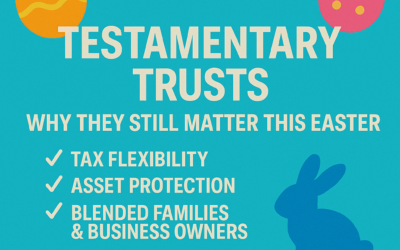
Testamentary Trusts – Why They Still Matter in 2025
As family structures, tax laws, and asset protection needs continue to evolve, testamentary trusts remain one of the most effective tools in estate planning. Here’s why they’re still front and centre in 2025: ✅ Tax Flexibility – Income can be distributed to...

Is a Will really enough to protect your family?
When it comes to planning your estate, one question can make all the difference: “Should I just make a Will… or consider a Testamentary Trust?” Here’s the simple truth: A Will is great for basic asset distribution. A Testamentary Trust gives your family ongoing...

Did You Know? Your Brand Could Be at Risk Without a Trademark!
A trademark is one of the most valuable assets a business can own. It distinguishes your brand from competitors, builds customer trust, and safeguards your reputation. Whether you’re a startup or an established company, securing a trademark is a crucial step in...
Organising Your Estate Planning Matters with Kalde Legal
Estate Planning Expert Organising Your Estate Planning Matters with Kalde Legal Estate planning is one of the most important steps you can take to ensure your assets are distributed according to your wishes and that your loved ones are cared for. At Kalde Legal, we...
Why Blended Families Face Higher Risks of Will Disputes
Why Blended Families Face Higher Risks of Will Disputes Blended families, which often consist of parents who have remarried and their children from previous relationships, are becoming increasingly common. While these families bring together diverse relationships and...
Contesting a Will?
Contesting a Will: What You Need to Know Losing a loved one is always difficult, but discovering that you have been left out of their will can make the situation even more challenging. If you believe you have been unfairly excluded or have not received adequate...
Is My Will Legal?
Is my will legal? There is a difference between a legal will and a will that works. A legal will is one that give your property away to other people after you die. A will that works is one that give it to the people you want to receive it. A legal will can still work...
Fixed fee in sale of business
Why don’t you do fixed fee for a sale of business? Many would-be business purchasers try to limit their transaction costs by asking that solicitors cap their costs. Here’s why we don’t agree to act for a fixed fee in sales of business transactions (this applies...
Commercial Leasing Expert
Leasing and propertyCommercial Leasing Lawyers Clear, Practical Advice For Commercial & Retail Leases Whether you are entering a new commercial lease, renewing an existing lease, negotiating terms, or dealing with a leasing dispute, Kalde Legal provides...
Are you a victim of a contested will?
Kalde Legal can help ensure you receive your fair share of any estate. Their team of experienced lawyers understand how emotionally difficult and legally complicated contested wills can be. They are dedicated to achieving the best possible outcome for their clients in...
Are you getting paid? Tips for debt recovery
Unfortunately, customers who don’t pay are a fact of life. Businesses go awry for various reasons and you end up not getting paid for stock you have already shipped. Most businesses’ client engagement documents are minimal or non-existent. We can design some new ones...
Picking the right location for your business.
Some businesses rely heavily on their location for success. It can be the difference between thriving and succeeding and struggling to make ends meet. Recognise the red flags before committing to the wrong property. For the sake of this article I will use the example...
One Will to Rule them All
We all need a will to deal with our estate and guide our loved ones about what we want done with our assets after we die. What happens when you have migrated to Australia from another county and still have assets there? You could be excused for thinking that a well...
Life as a Solicitor
Life as a Solicitor When Shakespeare wrote in Henry VI ‘first…kill all the lawyers,’ he was writing at a time where the monarch reigned supreme, and laws were quite literally the dictates of the ruler of the day – sometimes formulated at the whim of the king or queen....
Sale of Business Free Book
Eric Kalde is the author of over 30 practice guides published through the leading Australian legal publishers Precedents Online. Lawyers all over Australia rely on Eric Kalde’s precedents and practice guides in their legal practice. Always one to question the accepted...
Starting a Business in Australia
This is a book about starting a business. It provides a map, compass and checklist for starting a business from the ground up. I explain the process, and recommend the order in which you do things. I make suggestions about important steps, and factors you can give a...
Handy hints when selling your business.
Getting Ready for Sale Selling Your Business - Some helpful hints Maximise the selling price of your business before you list it for sale. Listing your business for sale without checking the things purchasers will look for first will cause you problems. The sale will...
Small Business Your Free Book
Small Business & The Law. WHY YOU MUST COMPLY The law (ASIC) enforces that a small business must comply under the laws whether you are a small business, business name or a registered company in Australia. As the business owner, you are responsible to...
Can I borrow money from my own company?
Can I borrow money from my own company? Yes, but be careful the ATO doesn’t tax you on it. Unwritten loans are taxed as dividends by the ATO. But there is a way to avoid this sneaky deeming provision. Read on. Those of you fortunate enough to own your own company may...